
pH Adjustment Systems – Complete Industrial Wastewater
Industrial pH Adjustment Systems for Wastewater Treatment
Industrial facilities generate wastewater streams with constantly changing pH levels. Whether the wastewater is highly acidic or strongly alkaline, the water must normally be neutralized before discharge to a sewer system or reuse process. A properly designed pH adjustment system protects equipment, helps facilities meet discharge permits, and prepares wastewater for additional treatment processes.
At Met-Chem, industrial wastewater treatment systems are custom engineered to fit each application. The goal is not simply to change the pH number on a screen. The goal is to create a stable, automated, and reliable treatment process that can continuously respond to changing wastewater conditions.
For companies searching for pH adjustment systems, pH neutralization systems, or industrial wastewater neutralization equipment, the most important factor is selecting a system that is properly designed for the chemistry and flow rate of the application.
For complete system details, equipment specifications, and project support, visit:
Industrial wastewater neutralization systems are commonly used in:
- Metal finishing and plating
- Chemical manufacturing
- Semiconductor production
- Battery recycling
- Printed circuit board manufacturing
- Food and beverage processing
- Pharmaceutical manufacturing
- Mining operations
- Automotive manufacturing
- Laboratory wastewater treatment
- Paint and coating operations
- Industrial cleaning systems
Wastewater treatment regulations commonly require industrial discharge streams to remain within a controlled pH range before entering municipal sewer systems or the environment.
What Is a pH Adjustment System?
A pH adjustment system is an industrial wastewater treatment process designed to automatically raise or lower pH levels using chemical dosing and process controls.
Most industrial wastewater streams require one of two treatment actions:
- Acid addition to reduce high pH wastewater
- Caustic addition to raise low pH wastewater
The process is controlled using pH probes, metering pumps, mixers, and automated control panels that continuously monitor wastewater conditions.
Modern systems often include:
- Equalization tanks
- Reaction tanks
- Chemical storage tanks
- Metering pumps
- pH probes
- Mixers
- PLC controls
- Alarm systems
- Clarifiers
- Sludge dewatering equipment
Met-Chem designs both single-stage and two-stage pH adjustment systems depending on the wastewater chemistry and discharge requirements.
How Industrial pH Adjustment Systems Work
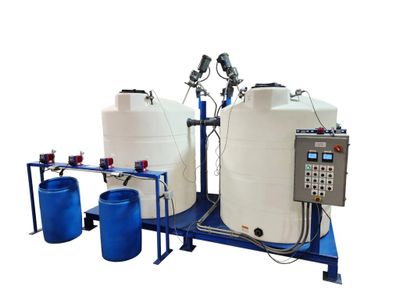
Step 1 – Wastewater Collection and Equalization
Wastewater first enters an equalization or holding tank where fluctuations in flow and chemistry can stabilize.
Equalization tanks help:
- Reduce chemical shock loads
- Blend varying wastewater streams
- Improve downstream chemical control
- Create more consistent treatment conditions
This step is extremely important because industrial wastewater chemistry often changes throughout the day.
Step 2 – Initial Chemical Dosing
The wastewater enters the first reaction tank where acid or caustic chemicals are added.
Common chemicals include:
Acids
- Sulfuric acid
- Hydrochloric acid
- Carbon dioxide
Caustics
- Sodium hydroxide
- Lime slurry
- Magnesium hydroxide
Automated metering pumps inject chemicals based on real-time pH readings.
Step 3 – Mixing and Reaction Time
Industrial mixers continuously agitate the wastewater to ensure proper chemical dispersion and complete reaction.
Proper mixing is critical because:
- Localized chemical concentrations can distort pH readings
- Incomplete mixing creates unstable pH control
- Poor agitation can create overdosing conditions
Met-Chem systems commonly use heavy-duty mixers with corrosion-resistant 316 stainless steel shafts for long-term industrial operation
Step 4 – Secondary Fine Adjustment
Many industrial systems use a second pH adjustment tank for fine tuning.
The first stage handles bulk pH correction.
The second stage provides precision control.
This two-stage design greatly improves stability and prevents overshooting the target pH.
Two-stage systems are especially valuable when:
- Wastewater chemistry fluctuates rapidly
- Metal precipitation is required
- Tight discharge limits exist
- Continuous flow treatment is used
Met-Chem commonly designs two-stage pH adjustment systems for industrial wastewater applications.
Single Tank pH Neutralization Systems
Single tank systems are commonly used for:
- Small wastewater generators
- Batch treatment operations
- Low daily wastewater volume
- Simpler discharge requirements
Advantages include:
- Lower initial cost
- Compact footprint
- Easier operation
- Future expandability
These systems are ideal for laboratories, small plating operations, and low-volume manufacturing facilities.
Two Stage pH Adjustment Systems
Two-stage systems are better for:
- Continuous wastewater flow
- Variable chemistry
- High flow rates
- Heavy metals precipitation
- Automated industrial systems
Advantages include:
- More stable pH control
- Better chemical efficiency
- Reduced overshooting
- Improved compliance reliability
Met-Chem commonly designs two-stage pH neutralization systems for flows ranging from 1 to 10,000 GPM.
Continuous Flow vs Batch pH Adjustment Systems
Continuous Flow vs Batch pH Adjustment Systems
Continuous Flow vs Batch pH Adjustment Systems

Continuous Flow Systems
Continuous systems treat wastewater continuously as it is generated.
These systems are ideal for:
- Large manufacturing facilities
- High flow rates
- 24-hour production
- Stable wastewater generation
Continuous systems often integrate with:
Batch pH Treatment Systems
Continuous Flow vs Batch pH Adjustment Systems
Continuous Flow vs Batch pH Adjustment Systems
Batch systems treat wastewater in controlled batches.
Advantages include:
- Greater operator control
- Better handling of variable chemistry
- Lower cost for smaller operations
- Easier startup and operation
Batch systems are extremely common in:
- Metal finishing
- Job shops
- Laboratory waste treatment
- Smaller industrial facilities